Digital Marketing Strategy

Digital Marketing Strategy Built From Your Economics, Not From a Channel Menu

A strategy is a set of decisions about where you will compete, what you will say, where you will invest and what you will stop doing. Most marketing plans avoid all four. BrandReturns builds digital marketing strategy from evidence — your data, your customers, your market and your margins — and hands you a roadmap specific enough that your team can start executing it the week it lands.

A short conversation about your objectives and where growth is currently stalling. No proposal until we understand the problem.

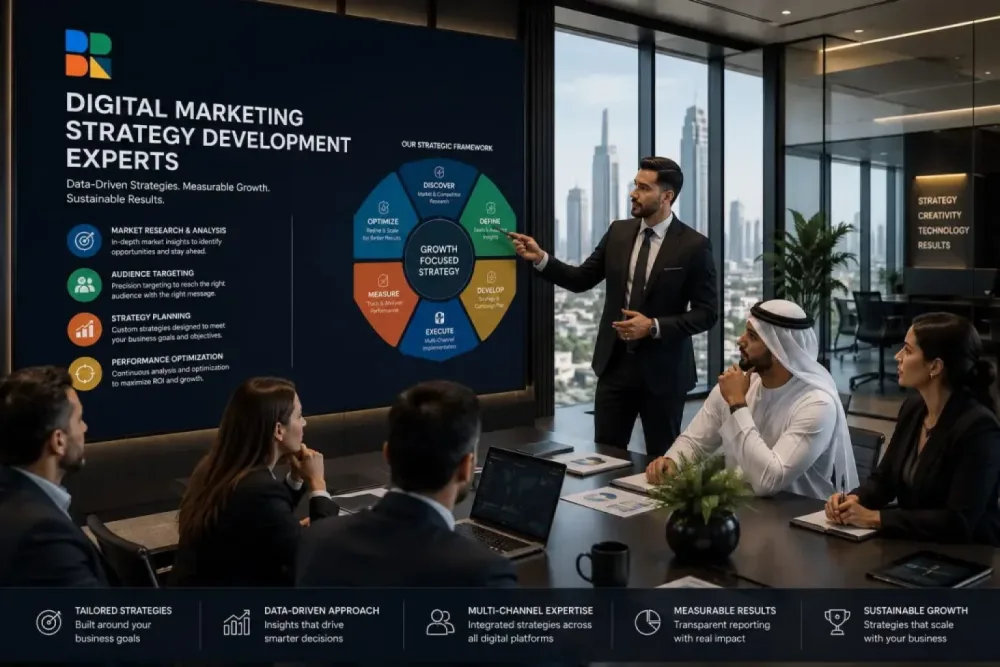
BrandReturns digital marketing strategy: discover, define, develop, execute, measure, optimize framework
logo img
logo img
logo img
logo img
logo img
logo img
logo img
logo img
logo img
logo img
logo img
logo img
logo img
logo img
logo img
logo img
logo img
logo img
logo img
logo img
logo img
logo img
logo img
logo img
logo img
logo img
logo img
logo img
logo img
logo img
logo img
logo img
logo img
logo img
logo img
logo img
logo img
logo img
logo img
logo img

You Do Not Have a Strategy Problem. You Have a Decisions Problem.

01

Budget is set by precedent, not by evidence.

This year's allocation is last year's allocation adjusted for optimism. Nobody has modeled what a reallocation would produce, so nobody proposes one.
02

Growth has plateaued and no one can name the constraint.

Is it demand, message, conversion, retention, price or distribution? Without a diagnosis, teams work harder on whichever part they personally own — which is rarely the part that is actually limiting the business.
03

Every vendor recommends their own specialty.

The SEO agency sees a content problem. The media buyer sees a budget problem. The web developer sees a site problem. All three may be partially right, and none of them is positioned to arbitrate.
04

You are entering a new market or launching a new product with no evidence base.

The instinct is to replicate what worked in the home market. Buying behavior, competitive density, platform ecosystems and price sensitivity rarely cooperate.
05

Board targets exist, but nothing connects them to marketing.

A revenue number was committed to. No one has worked backward from it to acquisition volume, conversion rate, permissible acquisition cost and required budget — so the target is a hope rather than a plan.
06

Your last strategy was a document, not an operating system.

It was thoughtful. It was presented. It was never translated into owners, sequence, budget and metrics, so within two months the team was back to running the previous playbook.
07

Your in-house team executes well but has no senior strategic direction.

Capable people producing competent work in the absence of a thesis about how the business wins.

None of this is solved by adding activity. It is solved by deciding.

20+

Years of experience

5

Global Locations

300+

Active Clients

2%

Top HubSpot Partners Globally

100+

In-house Digital Marketing Specialists

Strategy Is What You Choose Not to Do

01

We identify the binding constraint before recommending anything.

Marketing systems, like all systems, are limited by one thing at a time. Pouring budget into traffic when the constraint is conversion, or into conversion when the constraint is demand, produces expensive motion and no movement.
02

We work backward from the commercial target.

Revenue objective, margin structure, lifetime value, permissible acquisition cost, payback tolerance. If the math does not work, we would rather tell you in week three than have you discover it in month nine.
03

Evidence precedes opinion.

Customer interviews, sales call analysis, search demand data, competitive and category intelligence, historical performance forensics. Strategy built on assumptions is just a well-formatted guess.
04

We separate demand creation from demand capture.

Most plateaued businesses are excellent at capturing existing demand and have no mechanism for creating more of it. Deciding the ratio between the two is one of the highest-consequence decisions in the strategy.
05

We design for the team that has to execute it.

A strategy that requires capabilities, headcount or budget you do not have is not a strategy. Recommendations are sized against real resourcing, approval cycles and production capacity.
06

Every strategy ships with a measurement system.

If a plan cannot be proven wrong, it cannot be improved. We define the metric hierarchy, the baseline and the decision rules alongside the recommendations.
07

We assume it will need revision.

Markets move, platforms change, competitors respond. The strategy is built with a review cadence and defined triggers for reopening decisions.

Ready to see where your strategy has gaps?

Book a Strategy Consultation — a short conversation about your objectives and where growth is currently stalling.

Book a Strategy Consultation

The Workstreams Inside a Strategy Engagement

1

Growth Diagnostic & Marketing Audit

A forensic review of what already exists: historical channel performance, account structures, tracking integrity, funnel drop-off, content and search position, creative effectiveness and spend allocation. We audit against commercial outcomes rather than platform benchmarks.
Influences
budget efficiency decision accuracy elimination of unproductive spend
2

Market, Category & Competitive Intelligence

Demand landscape analysis, category dynamics, competitor positioning and spend patterns, share of search and share of voice, pricing context, and identification of unclaimed strategic ground. We map the competitive set by the position they occupy in the customer's mind.
Influences
positioning viability acquisition cost differentiation market entry decisions
3

Customer Research, Segmentation & ICP Definition

Qualitative interviews, sales and support call analysis, survey work where volume permits, purchase-trigger and objection mapping, and segmentation built on behavior and economic value rather than demographics alone.
Influences
lead quality conversion rate lifetime value acquisition cost
4

Positioning, Message Architecture & Offer Strategy

The strategic answer to why you rather than the alternative — a brand strategy and positioning statement, message hierarchy by segment and funnel stage, proof and objection-handling architecture, and an assessment of the offer itself.
Influences
conversion rate price realization creative effectiveness cost per acquisition
5

Customer Journey & Funnel Architecture

End-to-end mapping of how your customer moves from unaware to purchase to repeat, including the offline and human steps most digital maps omit — informed by the same evidence behind our website design and development recommendations.
Influences
conversion rate sales cycle length lead-to-close rate retention
6

Channel Portfolio Design, Budget Allocation & Forecasting

Assignment of a defined role to each channel — including paid media and performance marketing — allocation of budget between demand creation and demand capture, phasing across the planning horizon, and scenario modeling.
Influences
marketing efficiency ratio acquisition cost budget confidence forecast reliability
7

Measurement Framework, Data & Martech Architecture

Definition of the metric hierarchy, conversion and event taxonomy, tracking and server-side collection requirements, CRM integration, reporting structure, and the technology stack needed to support it — including where AI and automation services genuinely earn their place.
Influences
decision quality attribution accuracy speed of course correction operational cost
8

Roadmap, Resourcing & Operating Model

The sequenced plan: initiatives ordered by impact and dependency across 90-day, six-month and twelve-month horizons, with owners, effort estimates, budget implications, required capabilities and success criteria for each.
Influences
speed of execution accountability strategy adoption rate time to first result

What You Receive

01
  • Diagnostic findings with prioritized issues and quantified opportunity
  • Market, competitor and customer research synthesis
  • Positioning and message architecture
  • Journey and funnel map with identified failure points
  • Channel strategy with budget allocation model and scenario forecasts
  • Measurement framework, metric definitions and reporting specification
  • Martech and automation architecture recommendations
  • Sequenced execution roadmap with owners, effort and success criteria
  • A working session with your leadership and marketing team to transfer the thinking, not just the file

The Growth Blueprint

01 — Immerse
  • 1 Stakeholder interviews across leadership, marketing, sales, and service
  • 2 Commercial objectives and what's already been tried established
02 — Investigate
  • 1 Performance forensics, customer interviews, and competitor intelligence
  • 2 Findings logged as evidence with sources
03 — Diagnose
  • 1 Evidence consolidated into a single view of marketing maturity
  • 2 Binding constraint identified and tested with the client
04 — Model
  • 1 Unit economics, acquisition cost, and payback period established
  • 2 Budget scenarios modeled against explicit assumptions
05 — Design
  • 1 Positioning, segmentation, and channel portfolio designed
  • 2 Journey, measurement framework, and technology requirements set
06 — Sequence
  • 1 Recommendations converted into an ordered roadmap
  • 2 Owners, dependencies, effort, and budget assigned
07 — Enable
  • 1 Working session with the team who will execute
  • 2 Decision rules and the first ninety days walked through
08 — Recalibrate
  • 1 Optional quarterly review against actual performance
  • 2 Assumptions revisited, roadmap re-sequenced

A defined engagement with a fixed scope, timeline and deliverable set, run over six to ten weeks depending on complexity. Where BrandReturns is also engaged for digital marketing execution, the roadmap transitions directly into our delivery framework — but the strategy is written to stand alone and be executed by anyone competent.

Want the Growth Blueprint built for your business?

Talk to a strategist about what stage 01 — Immerse would surface for your team.

See What a Strategy Engagement Includes

Strategists Who Have Carried the Number

01

We execute what we recommend, which disciplines what we recommend.

Our strategists have run the accounts, built the funnels and answered for the results. That experience removes a category of recommendation that sounds sophisticated in a boardroom and cannot survive contact with a platform interface.
02

No channel quota to fill.

We are not compensated on where the budget goes. If the honest answer is that you should spend less on paid media and more on retention, product pages or price, that is the answer you will get.
03

Research depth, not desk research.

Recommendations are grounded in customer conversations, sales call evidence and performance forensics — not in category assumptions and a competitor's homepage.
04

Commercial modeling, not aspiration.

Scenarios are built on your margin structure with stated assumptions you can interrogate, and we show the range rather than a single flattering number.
05

Delivered as an operating plan.

Owners, sequence, effort, budget and success criteria. The test of a strategy is whether the team can act on it without us in the room.
06

No obligation to retain us for execution.

The engagement is priced and scoped as standalone work. Some clients hand the roadmap to their in-house team, some to their existing agencies, some back to us. All three are legitimate outcomes.
07

Multidisciplinary by default.

Strategy, brand, media, content, web, data and automation expertise inside one team, which means the recommendation is never limited by what a single specialism knows how to solve.
08

Built for cross-border realities.

Platform ecosystems, payment behavior, language, seasonality and regulation differ by market. Strategies for international expansion are built around those differences.

The Method Holds. The Strategic Question Changes.

Every engagement runs the same framework. What differs is which decision carries the most weight.

E-commerce and DTC

The dominant question is usually margin structure and repeat behavior — whether the business can afford its acquisition cost once fulfillment, discounting and returns are accounted for, and whether retention can raise the ceiling.

B2B SaaS and Technology

Segment prioritization, self-serve versus sales-led motion, and the balance between capturing existing category demand and creating demand for a category buyers do not yet search for.

Professional and Financial Services

Positioning and credibility architecture in markets where the offering is difficult to differentiate on features, plus lead qualification design so that volume does not consume senior billable time.

Healthcare and Clinical Services

What can be said, to whom, under which advertising restrictions — with journey design built around appointment behavior and local demand rather than national reach.

Education

Intake seasonality, long consideration windows and multi-stakeholder decisions between student, parent and funder, each requiring separate messaging within one funnel.

Real Estate and Property

Lead quality economics and response-time architecture, in a category where the majority of digital investment is lost between enquiry and first human contact.

Travel and Hospitality

Direct booking share versus intermediary dependence, demand volatility, and how much of the budget should be defending brand terms versus building unmediated demand.

Industrial and B2B Manufacturing

Long cycles, technical buyers and distributor relationships — where the strategic question is often whether digital should generate leads at all, or support a specification and relationship process that closes elsewhere.

Work That Moves Businesses Forward

Different industries. Different challenges. One principle: every strategy must create meaningful business value.

Luxury & Lifestyle case study
Luxury & Lifestyle

From Product to Desire

We transformed the brand's positioning through a refined identity, compelling storytelling and premium digital experiences—turning products into something audiences aspire to own.

  • Brand Strategy
  • Creative Direction
  • Social Media
  • Digital Marketing
View Case Study
Real Estate case study
Real Estate

Turning Developments Into Destinations

We connected premium positioning with digital campaigns and targeted lead generation—creating a stronger market presence and a clearer path from interest to inquiry.

  • Branding
  • Digital Strategy
  • Lead Generation
  • Performance Marketing
View Case Study
Automotive case study
Automotive

Driving Attention Into Action

We combined powerful creative, digital storytelling and performance marketing to strengthen brand consideration and turn audience attention into meaningful opportunities.

  • Creative Campaigns
  • Social Media
  • Content
  • Performance Marketing
View Case Study
Healthcare case study
Healthcare

Building Trust in a Digital-First World

We simplified complex services into a clear and credible brand experience—helping audiences understand the offering, build confidence and take the next step.

  • Brand Strategy
  • Website
  • Content
  • Digital Marketing
View Case Study
Technology case study
Technology

Making Innovation Easier to Buy

We transformed technical capabilities into a compelling commercial story, creating sharper positioning and a digital journey designed around modern B2B decision-makers.

  • Positioning
  • Website
  • B2B Marketing
  • Lead Generation
View Case Study
Hospitality case study
Hospitality

From Experience to Destination Brand

We brought the experience to life digitally through distinctive storytelling, content and campaigns designed to inspire discovery, engagement and bookings.

  • Brand Strategy
  • Content Creation
  • Social Media
  • Digital Campaigns
View Case Study
E-Commerce case study
E-Commerce

Turning Traffic Into Revenue

We connected customer acquisition, creative, conversion optimization and retention into one performance-focused ecosystem built to turn more visitors into customers.

  • Performance Marketing
  • E-Commerce
  • CRO
  • Retention Strategy
View Case Study
Financial Services case study
Financial Services

Making Confidence the Brand

We strengthened positioning and digital communication around what matters most in financial services—credibility, clarity and customer confidence.

  • Brand Strategy
  • Digital Experience
  • Content
  • Performance Marketing
View Case Study

Your Business Could Be Our Next Growth Story.

Every ambitious business has a challenge worth solving. Bring us yours, and let's discover what strategy, creativity and technology can achieve together.

Start Your Project

Strategy work is bought before its outcome can be observed, which makes accountability a fair concern. We handle it by defining, at the start, what the engagement must produce and how it will be evaluated at each horizon.

How to Judge a Strategy Before the Results Arrive

01

At delivery — clarity and decision readiness

  • Leadership and marketing can state the target segment, positioning, permissible acquisition cost and payback expectation without referring to the document
  • Every initiative on the roadmap has an owner, an effort estimate and a success criterion
  • A verified performance baseline exists, with agreed metric definitions
  • The list of activities being discontinued is explicit, and the budget released by them is reallocated
02

At 90 days — adoption and early signal

  • Proportion of the roadmap actually initiated
  • Reallocated budget in market and performing against modeled expectations
  • Measurement infrastructure implemented and reporting against the defined hierarchy
  • Testing velocity: number of structured experiments live against plan
  • Early directional movement in conversion rate, lead quality and cost per qualified outcome
03

At 6 to 12 months — commercial outcome

  • Blended customer acquisition cost against the baseline established at engagement start
  • Marketing efficiency ratio and contribution margin after media and fulfillment
  • Lifetime value to acquisition cost ratio and payback period
  • Qualified pipeline volume and pipeline-to-close rate for considered-purchase models
  • Share of search and unprompted brand demand, where demand creation was part of the plan
  • Forecast accuracy: how closely actual performance tracked the modeled scenario, and what the variance teaches us

On projections. We model outcome ranges from your data with assumptions stated and open to challenge. We do not present single-point forecasts, and we do not attach performance figures from other clients to your business — different market, different margin, different starting position.

Frequently Asked Questions

1. Do we have to hire BrandReturns for execution afterward?
No. The engagement is scoped, priced and delivered as standalone work, and the roadmap is written so that your in-house team or your existing agencies can execute it. We would rather be chosen for digital marketing execution on the strength of the thinking than have it assumed as a condition.
2. How long does a strategy engagement take?
Most run six to ten weeks. Single-market, single-channel-focused engagements can complete faster; multi-market or multi-product scopes with primary customer research take longer. The variable is almost always research depth and stakeholder availability, not analysis time.
3. How is it priced?
As a fixed-fee project, agreed after the scoping conversation. The factors that move it are the number of markets and product lines, whether primary customer research is included, the state of your existing data and tracking, the number of stakeholders to be interviewed, and whether measurement and martech architecture are in scope. Fixed fee rather than time-based, so that thoroughness is not something you are charged extra for.
4. We already have a strategy. Would this replace it?
Not necessarily. We begin by auditing what exists. Sometimes the existing strategy is sound and the failure is in sequencing, measurement or execution capability, in which case saying so is the more useful output. Where we disagree with the existing direction, you will get the evidence for the disagreement rather than an assertion.
5. How is this different from the free audit or proposal an agency offers?
A pre-sales audit is a sales instrument — it is designed to identify problems that the agency's services happen to solve, and it is constrained to whatever can be found without access to your data. A strategy engagement has access to your performance data, margin structure, CRM, sales team and customers, takes weeks rather than hours, and is under no obligation to arrive at a conclusion that involves hiring us.
6. Will it work with our in-house team and current agencies?
It is designed to. The roadmap assigns owners across whoever is actually doing the work, and the operating model section addresses how internal and external parties coordinate. Where existing partners are performing well, the strategy is written to direct them better rather than replace them.
7. What do you need from us?
Access to performance data, analytics and CRM; visibility of margin and lifetime value; two to four hours of stakeholder time across leadership, marketing and sales; introductions to a small number of customers for interviews; and a single decision-maker who can approve the direction. Engagements slow down for one reason more than any other, which is delayed access to data.
8. How often should a strategy be revisited?
Quarterly at a light level, annually at depth — sooner if a material assumption breaks. We define the specific triggers that should reopen a decision, such as a shift in acquisition cost beyond a set threshold, a competitor entering a position we claimed, or a platform change affecting a channel the plan depends on.

The Most Expensive Marketing Is the Kind Nobody Decided On

Budget spent without a thesis does not fail loudly. It produces reports, activity and a slow erosion of the margin that was supposed to fund your growth. If you can name your growth objective but not the plan that reaches it, that is the conversation to have. Tell us your objective and where growth is stalling — we will tell you what we would need to look at, what the engagement would involve, and whether you need one at all.

Book a Strategy Consultation

Tell us your objective and where growth is stalling. We will tell you what we would need to look at, what the engagement would involve, and whether you need one at all.

United States

BrandReturns Global LLC

Wyoming, United States

Corporate Address

30 N Gould St
Ste R
Sheridan, WY 82801
United States

Phone

+1 646-347-1661

Email

info@brandreturnsglobal.com

Tell Us About Your Project

By submitting this form, you agree that BrandReturns may use the information provided to respond to your enquiry and communicate with you about relevant services. Your information will be handled in accordance with our Privacy Policy.

WhatsApp