Google Ads Agency

A Google Ads Agency for Buying Demand You Do Not Already Own

Search advertising captures demand that already exists, which makes it the most efficient channel available and the easiest to flatter. The fastest way to improve an account's reported return is to spend more on your own brand name — buying clicks from people who were looking for you anyway. BrandReturns runs Google Ads accounts on what they add rather than what they can be credited with: brand spend tested for incrementality, automation governed rather than surrendered to, search terms mined every week, and reporting reconciled against your revenue. Google Ads was called AdWords until 2018 — the platform is the same; the discipline has changed considerably since.

We review account structure, wasted spend, tracking integrity, automation settings and the split between branded and non-branded performance.

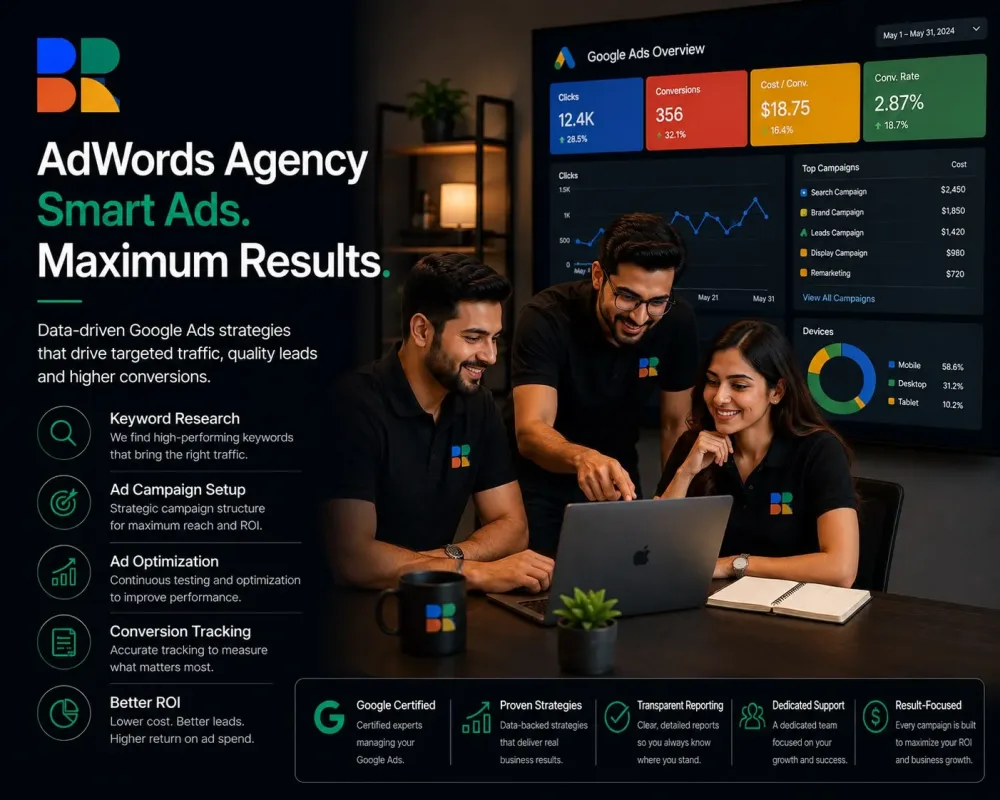
Google Ads Agency visual
logo img
logo img
logo img
logo img
logo img
logo img
logo img
logo img
logo img
logo img
logo img
logo img
logo img
logo img
logo img
logo img
logo img
logo img
logo img
logo img
logo img
logo img
logo img
logo img
logo img
logo img
logo img
logo img
logo img
logo img
logo img
logo img
logo img
logo img
logo img
logo img
logo img
logo img
logo img
logo img

The Return Looks Excellent Because You Are Buying Your Own Customers

01

The return on ad spend is impressive and it is mostly your brand name.

People searching for you specifically, who would have arrived through the organic result underneath. Reported as advertising performance, funded from the advertising budget, and never tested.
02

Costs per click rise every year and the response is to accept it.

Auction pressure is real. So is a keyword set that has not been reviewed in two years, a quality score problem nobody is working on, and a landing page that has never been tested.
03

Performance Max is spending and nobody can see where.

Budget flowing into a campaign type that reports at a summary level, absorbs shopping and brand traffic that would have converted anyway, and resists the diagnosis that would reveal it.
04

Settings changed and nobody approved them.

Automatically applied recommendations altering match types, budgets and bidding, enabled by default, and discovered afterwards in a change history.
05

The account has four hundred keywords and forty that matter.

Structural complexity accumulated over years, dividing conversion data until no campaign has enough for the bidding to work properly.
06

Money is going to search terms you would never have chosen.

Broad matching with an unmaintained negative list, delivering queries adjacent to your business, related to your category but not your offer, or from people looking for a job.
07

The agency charges a percentage of spend.

Which means every recommendation to increase budget is also a recommendation to increase their fee, and no recommendation to reduce it is ever likely to arrive.
08

Leads arrive and sales rejects them.

The account is optimised toward form submissions, the platform is very good at generating form submissions, and nobody fed the outcome of those submissions back into the system.
09

You scaled the budget and the cost per acquisition rose sharply.

Because search demand is finite, the cheapest available intent is purchased first, and nobody modelled what would happen at three times the spend.

20+

Years of experience

5

Global Locations

300+

Active Clients

2%

Top HubSpot Partners Globally

100+

In-house Digital Marketing Specialists

Test the Brand Spend, Govern the Automation, Mine the Queries

01

Brand terms are tested rather than assumed.

There are legitimate reasons to bid on your own name — competitors appearing above you, control of the message, occupying the results page. There are also accounts spending a substantial share of budget to buy traffic that would have arrived free, while the resulting return flatters the whole account. We establish this with a holdout test rather than an opinion, and we report branded and non-branded performance separately from the first month.
02

Automation is governed, not surrendered to.

Smart bidding and automated campaign types work well when the conversion signal is clean and the account is structured to give them good inputs. They fail expensively when they are fed unvalidated conversions or asked to optimise across a poorly defined mix. We use them deliberately, with clear boundaries, and we turn off automatically applied recommendations by default so that no change happens without a decision.
03

The search terms report is where the account is actually managed.

Match types have loosened, automated matching has expanded, and the practical work has moved from choosing keywords to reviewing what the platform actually served against. Weekly query mining, negative list development and structural adjustment based on real search terms rather than on planned ones.
04

Signal quality determines what the bidding can achieve.

Conversion tracking verified rather than assumed, offline and CRM conversions imported where the sale completes away from the site, and value-based signals where margin varies across products. An account optimising toward the wrong event will do so very efficiently.
05

Structure exists to concentrate data, not to demonstrate control.

Automated bidding needs conversion volume to learn from. Accounts fragmented into many small campaigns divide that volume until nothing has enough. We consolidate deliberately and keep the account simple enough to read.
06

Search has a ceiling and we will tell you where it is.

You cannot buy more demand than exists. Scaling means expanding into adjacent intent, new markets or lower-intent terms, all of which have worse economics than the demand you are already capturing — or it means creating demand instead of capturing it, through channels like social media advertising. We model the curve, and when marginal spend stops clearing your permissible cost, we say so rather than continuing to grow a number.
07

The landing experience is part of the account's performance.

Message match, page speed, form friction and mobile experience affect both conversion rate and what you pay per click. It is frequently the cheapest available improvement and it sits outside the platform, which is why it is so often left alone.
08

Paid and organic search are looked at together.

Where you rank organically for a term, paid clicks on it may be less incremental. Where you do not, paid coverage matters more. Managing the two channels in isolation reliably produces overlap nobody has quantified — which is why we look at this alongside our wider SEO services.
09

We are not paid a percentage of your media spend.

That structure rewards an agency for recommending larger budgets at exactly the moment your interests may require a smaller one.

Not sure how much of your return is actually incremental?

Request a Google Ads Audit and we'll review structure, wasted spend, tracking integrity and automation settings.

Request a Google Ads Audit

The Components of a Managed Google Ads Programme

1

Account Audit, Structure & Rebuild

Assessment of campaign architecture, settings, wasted spend, tracking integrity, automation configuration and historical performance, followed by restructuring where fragmentation or accumulated complexity is limiting the account. Includes the settings that quietly waste budget by default — network expansion, automatically applied recommendations and inherited targeting.
Influences
wasted spend bidding effectiveness reporting clarity cost per acquisition
2

Keyword & Search Term Strategy

Intent-led keyword research weighted by commercial value, match type strategy suited to current platform behaviour, negative keyword architecture, and weekly search term mining. The negative list is a live asset requiring continuous maintenance rather than a one-off setup task.
Influences
relevance wasted spend lead quality cost per click
3

Bidding, Budget & Automation Governance

Bid strategy selection against your commercial targets, budget allocation and pacing, conversion value configuration, and deliberate management of automated campaign types with clear boundaries on what they may absorb. Includes disabling automatic recommendation application so account changes remain decisions.
Influences
cost per acquisition delivery stability budget control transparency
4

Ad Copy, Assets & Testing

Responsive search ad asset development, message testing against distinct angles rather than cosmetic variations, extension and asset configuration, and copy written to qualify as well as attract — stating price ranges, minimum requirements or audience fit where doing so improves lead quality more than it reduces volume, in service of the same qualification discipline behind lead generation.
Influences
click-through rate quality score lead quality cost per click
5

Landing Page & Conversion Path

Message match between ad and destination, page speed, form design and friction, mobile experience, and structured testing of the post-click experience — occasionally requiring the same website design and development work behind any other page. Conversion improvements apply across every campaign simultaneously at no additional media cost.
Influences
conversion rate quality score cost per acquisition return on existing spend
6

Shopping, Merchant Center & Feed Management

Product feed structure and optimisation, Merchant Center health and disapproval resolution, product titles and attributes built for how people search, campaign structure for shopping inventory, and promotion and pricing data. For retail accounts the feed is the campaign — targeting, relevance and eligibility all derive from it.
Influences
shopping impression share feed eligibility product-level performance revenue
7

Measurement, Conversion Tracking & Incrementality

Conversion tracking implementation and validation, offline and CRM conversion import — coordinated with CRM and email marketing where the sale completes away from the site — value-based configuration, attribution model selection, brand term incrementality testing, and reporting reconciled against your actual revenue rather than presented from the platform alone.
Influences
optimisation quality budget allocation accuracy proof of contribution
8

Beyond Search: YouTube, Demand Gen, Display & Local

Video and Demand Gen campaigns where creating demand rather than capturing it is the objective, remarketing configured proportionately, display used deliberately rather than by default, and Local Services or location-led campaigns for businesses whose customers search with local intent.
Influences
reach beyond existing demand growth ceiling local enquiry volume
9

Account Governance, Waste Control & Invalid Traffic

Ongoing monitoring of spend distribution, disapprovals and policy compliance, change history review, competitor and trademark issues, budget pacing, and monitoring for invalid or fraudulent click activity with exclusion management where patterns emerge.
Influences
budget efficiency account continuity protection against avoidable loss

The Incremental Account

01 — Audit
  • 1 Structure, settings, wasted spend, tracking integrity
  • 2 Branded vs non-branded split established as a baseline
02 — Instrument
  • 1 Conversion tracking verified
  • 2 Offline/CRM conversions imported, value-based signals configured
03 — Define
  • 1 Margin structure, permissible CPA, payback tolerance
  • 2 Realistic demand ceiling in your category estimated
04 — Restructure
  • 1 Campaign architecture consolidated for data concentration
  • 2 Match types and negative architecture rebuilt
05 — Automate
  • 1 Bidding strategies deployed with defined boundaries
  • 2 Auto-recommendation application disabled, learning respected
06 — Test
  • 1 Ad copy at concept level, landing page experiments
  • 2 Incrementality testing, including a brand term holdout
07 — Expand
  • 1 Adjacent intent, new markets, other Google surfaces
  • 2 Where the search ceiling has been reached
08 — Control
  • 1 Weekly search term mining, negative development
  • 2 Spend monitoring, disapproval/policy management, invalid traffic
09 — Report
  • 1 Branded and non-branded performance separated
  • 2 Reconciled against revenue, incrementality reported honestly

Working cadence: daily pacing checks, weekly search term and optimisation review, monthly commercial reporting against blended metrics, quarterly incrementality testing and structural reassessment.

Is Performance Max quietly absorbing credit it didn't earn?

Talk to a Paid Search Strategist about constraining it and measuring what it's genuinely adding.

Talk to a Paid Search Strategist

We Will Test Whether Your Best-Performing Campaign Does Anything

01

Brand spend tested with a holdout.

The campaign reporting the strongest return is frequently the one contributing least. We measure it rather than defend it, and where the result says reduce, that is the recommendation.
02

Branded and non-branded reported separately from month one.

It makes our numbers smaller and it makes them mean something.
03

Automatically applied recommendations disabled by default.

No change to your account happens without a decision, and you can verify this in the change history at any time.
04

Search terms mined weekly.

Not monthly, and not when performance dips. The negative list is a maintained asset, and neglecting it is where broad matching becomes expensive.
05

Not paid a percentage of spend.

We have no financial interest in your budget being larger than it should be.
06

Automation used with boundaries.

Automated campaign types deployed where they perform and constrained so they do not absorb traffic that would have converted regardless, with the structure kept legible enough to diagnose.
07

Honest about the ceiling.

When search demand in your category is exhausted, we will say so and discuss what creating demand would require rather than pushing budget into progressively worse intent.
08

Paid and organic assessed together.

Overlap quantified rather than ignored, and coverage decisions made with your organic position in view.
09

Full ownership.

Your Google Ads account, Merchant Center, conversion configuration, audiences, ad assets and historical data belong to you and remain with you.

Where Paid Search Economics Differ

E-commerce and Retail

Shopping and feed quality determine most of the outcome, with margin after fulfilment and returns as the real measure. New customer acquisition cost matters more than blended return inflated by repeat buyers.

Home and Local Services

Very high commercial intent, strong local dependence, expensive clicks and a business outcome decided as much by response speed as by the campaign. Call tracking and lead qualification are essential rather than optional.

Legal, Financial and Insurance

Among the most expensive clicks in search, with regulatory constraints on claims and a lead quality problem that only offline conversion feedback can solve. Small improvements in qualification are worth more than large improvements in volume.

Healthcare and Clinical Services

Restricted categories, sensitive targeting limitations and measurement that should run on appointments attended rather than enquiries generated.

B2B Technology and SaaS

Small qualified audiences, high click costs, long cycles, and a strong requirement to feed closed-won data back into the account. Optimising toward form fills in this category reliably buys volume nobody wants.

Education

Seasonal intake cycles against long decision periods, with measurement on enrolment rather than enquiry and nurture carrying the distance between them.

Travel and Hospitality

Heavy intermediary competition on the same queries, volatile demand and pricing, and direct booking value as the objective rather than raw conversion volume.

Multi-Location Businesses

Location-level campaign structure, budget allocation across sites with different demand, and the governance question of what head office controls and what local operators can adjust.

Judged on Non-Branded Performance and Contribution

01

Commercial outcomes

  • Contribution margin after media, cost of goods and fulfilment
  • Cost per acquisition on non-branded campaigns specifically
  • Blended customer acquisition cost across all marketing investment
  • Incremental revenue established through holdout testing, including on brand terms
  • New customer acquisition cost, separated from returns inflated by repeat purchasers
  • Payback period and lifetime value to acquisition cost ratio
02

Account diagnostics

  • Search term relevance and the proportion of spend on queries you would have chosen
  • Wasted spend as a percentage of total, tracked as a working metric
  • Impression share, with lost share attributed correctly to budget or to rank
  • Conversion rate by campaign type and device
  • Cost per click trend against auction pressure
  • Quality score components read as diagnostics of relevance rather than as a target
03

Leading indicators

  • Negative keyword additions per week
  • Proportion of budget in campaigns still learning
  • Disapproval and policy issue rate
  • Testing velocity on ads and landing pages

On the demand ceiling. Search advertising cannot create demand; it captures what exists. Every category has a finite volume of commercial-intent queries, and once you are capturing most of them, additional budget buys progressively worse intent at progressively worse economics. We model where that point sits and say when it has been reached, because the alternative is a slowly declining account described as growth.

On brand terms. We will run a holdout test on brand campaigns where account scale permits. In some accounts the result justifies the spend comfortably — competitors bidding, message control, results-page occupancy. In others it shows most of that traffic arriving regardless. Both outcomes are useful, and only one of them is ever assumed.

On horizons. Structural fixes and waste reduction show within weeks. Bidding strategies need one to two weeks to stabilise after significant changes. Incrementality tests require several weeks to reach usable confidence. Seasonality means year-on-year comparison is the only honest one in most categories, which is why the first twelve months of any account are partly a data-gathering exercise.

Frequently Asked Questions

1. Should we bid on our own brand name?
Sometimes, and it should be tested rather than assumed. Legitimate reasons include competitors appearing above your organic listing, control over the message and offer, and occupying more of the results page. The counter-argument is that you may be paying for clicks that would have arrived through your organic result. A holdout test settles it in a few weeks, and it is the single most valuable test available in most mature accounts.
2. What is the minimum budget worth starting with?
Enough for the account to generate sufficient conversion volume for automated bidding to learn from, which depends on your cost per acquisition rather than on a universal figure. Where budget is limited, we concentrate on the highest-intent terms in one campaign rather than spreading thinly — a small budget divided across search, shopping and display usually produces three campaigns that never leave learning.
3. Is Performance Max worth using?
It performs well in some accounts and absorbs credit for existing demand in others, which is why it needs constraints rather than either enthusiasm or refusal. We use it where the evidence supports it, with brand exclusions, feed and asset control, and separate measurement of what it is genuinely adding. What we will not do is let it run unbounded and report the resulting figure as performance.
4. Why is our cost per acquisition rising?
Usually some combination of auction pressure, creative and ad fatigue, a landing page that has not improved, an unmaintained negative list, or scaling past the point where the cheapest intent is already captured. The audit distinguishes between them, because the remedies are entirely different and treating a demand ceiling as an optimisation problem wastes a great deal of budget.
5. How is this priced?
As a monthly retainer based on scope — account complexity, number of markets and languages, shopping and feed requirements, and measurement work needed. Media spend is paid directly by you to Google. We do not price as a percentage of ad spend, because it creates a direct incentive to recommend larger budgets regardless of whether marginal spend is profitable.
6. Who owns the account and the data?
You do. The Google Ads account, Merchant Center, conversion configuration, audience lists, ad assets and historical performance data are established in your ownership with us granted access, and they remain with you if the engagement ends.
7. Google says our optimisation score is low. Should we act on it?
Selectively. Some recommendations are genuinely useful, particularly on tracking and disapprovals. Many involve increasing budgets, loosening match types or enabling network expansion — changes that increase spend with the platform, which is the party generating the recommendation. We review them individually and disable automatic application, so the score reflects our judgement rather than governs it.
8. Can you scale our budget without the cost per acquisition rising?
Usually not indefinitely, and any agency saying otherwise is not describing search. The most responsive demand is purchased first, so cost rises as you expand into adjacent and lower-intent queries. We model the expected curve, identify the point where marginal spend stops clearing your permissible cost, and where further growth is required, we discuss the channels that create demand rather than capture it.

The Best-Performing Campaign in Your Account May Be Doing Nothing

Paid search flatters. It intercepts people at the moment they act, records the sale, and reports a number that looks like proof. Some of that number is demand you created and captured. Some of it is demand you already had, purchased back from the platform at a click price. Separating the two is the whole job, and it is not difficult — it is simply rarely in anyone's interest to do it.

Request a Google Ads Audit

We will review structure, wasted spend, tracking integrity and automation settings, and show you your branded and non-branded performance separately.

United States

BrandReturns Global LLC

Wyoming, United States

Corporate Address

30 N Gould St
Ste R
Sheridan, WY 82801
United States

Phone

+1 646-347-1661

Email

info@brandreturnsglobal.com

Tell Us About Your Project

By submitting this form, you agree that BrandReturns may use the information provided to respond to your enquiry and communicate with you about relevant services. Your information will be handled in accordance with our Privacy Policy.

WhatsApp