Social Media Community Management

Social Media Community Management for Everything That Happens After You Post

Publishing is the easy half. The commercial half is the comment with a purchase question, the message that arrives at nine on a Saturday evening, the complaint sitting publicly under your best-performing post, and the community that either sustains itself or quietly empties. BrandReturns runs that side as an operational discipline — written policy, defined response times, trained people, escalation agreed in advance, and reporting on revenue and resolution rather than reply counts.

We assess your current response times, unanswered volume, sentiment, moderation practice and escalation readiness — and show you what is being lost in the gaps.

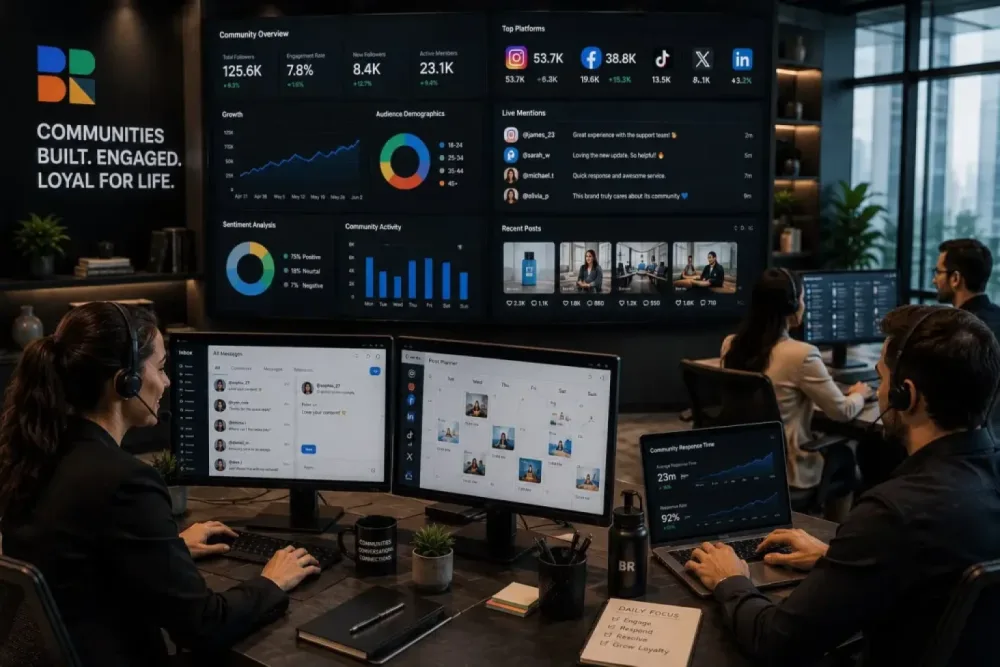
BrandReturns social media community management: engagement, sentiment and response dashboard
logo img
logo img
logo img
logo img
logo img
logo img
logo img
logo img
logo img
logo img
logo img
logo img
logo img
logo img
logo img
logo img
logo img
logo img
logo img
logo img
logo img
logo img
logo img
logo img
logo img
logo img
logo img
logo img
logo img
logo img
logo img
logo img
logo img
logo img
logo img
logo img
logo img
logo img
logo img
logo img

The Inbox Is a Revenue Channel That Nobody Owns

01

Purchase enquiries go cold in the inbox.

Someone asks about price, availability, sizing or lead time — the highest-intent moment a person will ever reach — and receives a reply the following afternoon, by which point they have bought from whoever answered first.
02

Complaints stay visible under your most-viewed content.

Every new viewer sees the unanswered grievance before they see anything you wrote. Silence reads as confirmation.
03

Marketing thinks support owns it; support thinks marketing does.

So it is handled by whoever notices, inconsistently, with no record of what was promised to whom.
04

Volume arrives when nobody is staffed.

Evenings, weekends, public holidays, campaign launch days and the moment something goes wrong. Coverage is designed around office hours; conversation is not.
05

Three people reply in three different voices.

One formal, one overly casual, one defensive. The account reads as a committee, and in a public thread that inconsistency is the whole brand impression.
06

Negative comments get deleted, and that becomes the story.

The instinct to remove criticism reliably escalates it, because the screenshot already exists and removal converts a complaint into a grievance about censorship.
07

The same customer explains their problem three times.

No conversation history, no CRM connection, no continuity between the person who replied on Tuesday and the person who replied on Thursday.
08

A crisis is handled by whoever is awake.

No severity definitions, no holding statement, no agreed approval route, and therefore hours lost deciding who is allowed to say something while the conversation compounds.
09

The community you launched is a ghost town.

A group or server was created, seeded with announcements, and abandoned by members within a month — because it was built for the brand's convenience rather than around a reason for people to return.
10

Everything depends on one person.

The tone, the history, the judgement about what to escalate. When they leave, the capability leaves with them and the next hire starts from nothing.

20+

Years of experience

5

Global Locations

300+

Active Clients

2%

Top HubSpot Partners Globally

100+

In-house Digital Marketing Specialists

Written Policy, Defined Coverage, Measured Response

01

We treat response time as the primary operational metric.

Conversion from a messaged enquiry declines sharply with delay, and reputational damage from an unanswered public complaint compounds with visibility. Everything else in the operation — staffing, tooling, escalation, tiering — exists to protect response time on the interactions where it matters most.
02

Not every message deserves the same speed or the same person.

We tier interactions: purchase enquiries and service failures get the fastest human response; routine questions get accurate answers from a maintained response library; spam and bad-faith provocation get a documented handling rule rather than an improvised argument. Treating everything identically means the valuable interactions wait behind the trivial ones.
03

Coverage is designed around when volume actually occurs.

We look at your historical message and comment distribution by hour and day before proposing a staffing model, because conversation clusters in evenings, weekends and incident windows. A five-day business-hours model applied to a channel with weekend peaks is a decision to lose the weekend.
04

Moderation policy is written before the first reply.

What is answered, what is hidden, what is deleted, what is escalated and what is deliberately ignored — documented, approved by you, and applied consistently. Hiding spam and deleting criticism are different acts with different consequences, and the distinction needs to exist on paper rather than in a moderator's judgement at eleven at night.
05

Escalation is agreed while nothing is happening.

Severity tiers, holding statements, named decision-makers, out-of-hours contacts and approval routes are documented in advance. In an incident, response speed is determined almost entirely by how much was decided beforehand.
06

A community needs a reason to exist that serves its members.

Groups and servers built as a broadcast convenience for the brand empty out. Ones built around a shared problem, a recurring ritual, useful peer access or genuine early information sustain themselves. We would rather tell you not to launch a community than staff one that will be dead in six weeks.
07

The goal is a community that answers itself.

In healthy communities most participation comes from a small minority of members, and the strongest signal of health is the ratio of member-to-member replies against brand-to-member replies. We design for contribution — recognition, moderator development, rituals, structured ways for experienced members to help newer ones — because peer support scales in a way that staffing does not.
08

AI triages; people respond where it counts.

Automated classification, routing, translation, draft suggestions and out-of-hours acknowledgment reduce delay meaningfully. Anything carrying emotional weight, reputational risk, a complaint, a commitment or a commercial negotiation is handled by a named person. Customers can tell, and the moments where they can tell are the ones that matter.
09

Nothing lives in one person's head.

Response libraries, tone documentation, conversation logs, escalation history and community knowledge bases are maintained as assets. Continuity through staff changes is a design requirement, not a hope.
10

Listening only creates value if the business can act.

We route recurring objections, product complaints and feature requests to the teams who can address them. Where an organization surfaces problems and changes nothing, an active community accelerates reputational damage rather than preventing it — and we will say so before the programme starts.

Someone in your inbox is waiting right now

Request a Community Operations Review and we'll assess your response times, unanswered volume, sentiment, moderation practice and escalation readiness.

Request a Community Operations Review

The Components of a Managed Community Operation

1

Community Strategy & Governance Framework

The foundational documentation: community charter and purpose, tone and voice guidance for conversation rather than publication, moderation policy, escalation matrix with severity tiers and decision rights, coverage model, and the service levels attached to each interaction type. This is the layer that makes consistent judgement possible across multiple people, shifts and time zones. Operations without it produce a different brand personality every day.
Influences
consistency response reliability risk exposure quality of judgement under pressure
2

Daily Community Management & Moderation

Ongoing handling of comments, mentions, tags, replies and reviews across your channels: answering questions, welcoming and acknowledging, surfacing conversation worth amplifying, and applying the moderation policy to spam, abuse and bad-faith activity. Active comment sections generate further distribution on most platforms, which makes engagement a reach mechanism as well as a service function.
Influences
reach and distribution sentiment response time community perception
3

Conversational Sales & Enquiry Handling

Management of direct messages and comment-based enquiries as a commercial channel: qualification, accurate product and pricing information, objection handling, routing into your CRM or sales team, follow-up on unresolved conversations, and handover protocols. In many markets messaging carries a larger share of purchase conversation than any web form, and it is routinely staffed as though it were correspondence — the same discipline behind our lead generation work applies to the conversations already arriving in your inbox.
Influences
enquiry conversion revenue from messaging speed to first response sales pipeline
4

Social Customer Care & Issue Resolution

Front-line handling of service issues raised publicly and privately, with defined resolution paths, integration with your support system or helpdesk, tracking through to closure, and the judgement of what is resolved in public versus moved to a private channel. Handled well, this reduces support load elsewhere while converting visible complaints into visible resolutions.
Influences
resolution rate support ticket deflection customer retention public sentiment
5

Owned Community Building & Programming

Design, launch and ongoing programming of communities you control — Discord servers, WhatsApp and messaging groups, Facebook Groups, forums, membership spaces and customer communities. Includes member journey design, onboarding, recurring rituals and events, moderator recruitment and training, recognition systems and health management. Platform audiences are rented; an owned community is an asset that survives algorithm changes and reaches members directly.
Influences
retention lifetime value support deflection direct reach independent of platforms
6

Advocacy, User-Generated Content & Ambassador Programmes

Identification of genuinely enthusiastic customers, structured ambassador and advocacy programmes, user-generated content sourcing with proper rights permission workflows, and the systems that turn satisfied members into a supply of credible content and referrals. Customer-created material consistently outperforms brand-produced advertising in social environments and costs a fraction to obtain, provided the permissions are handled correctly — sourced material regularly feeds directly into our content creation and distribution work.
Influences
referral volume content supply paid social performance credibility
7

Reputation & Review Management

Structured monitoring and response across review platforms, app stores, map listings and employer review sites, with response frameworks by rating and issue type, escalation of serious complaints, and programmes to generate reviews from satisfied customers at the right moment. Review presence is frequently the last thing a buyer checks and one of the first things AI-assisted research summarizes — and it compounds the same trust signals we build through brand awareness and visibility work.
Influences
conversion rate local discovery average rating buyer confidence
8

Crisis Response & Escalation Operations

The runbook: severity definitions, pre-approved holding statements, escalation contacts and decision rights, out-of-hours activation, coordinated response across channels, volume surge handling, and post-incident review. Also periodic rehearsal, because a protocol nobody has practised tends to fail in exactly the conditions it was written for.
Influences
incident duration reputational damage response speed organizational confidence
9

Listening, Voice-of-Customer Intelligence & Reporting

Sentiment monitoring, categorization of recurring themes, competitor conversation analysis, structured routing of product and service feedback to the relevant internal teams, community health reporting, and commercial reporting on enquiries, conversions and resolutions. Community operations sit closer to the unfiltered customer than any other marketing function, which makes it the cheapest research the business has access to, and feeds directly into digital marketing strategy decisions.
Influences
product and service decisions message accuracy early risk detection sales enablement

The Presence Protocol

01 — Charter
  • 1 Purpose, audience and outcomes the community must influence
  • 2 For owned communities: the honest test of whether one should exist
02 — Codify
  • 1 Moderation policy, tone guidance and response library
  • 2 Escalation matrix with severity tiers and named decision-makers
03 — Staff
  • 1 Coverage model built from actual volume distribution
  • 2 Roles, tooling, routing and CRM/helpdesk integration
04 — Respond
  • 1 Daily operation against agreed service levels
  • 2 Everything logged so continuity survives shift changes
05 — Cultivate
  • 1 Recurring formats, events and member recognition
  • 2 Structures that let members help each other, not just the brand
06 — Convert
  • 1 Enquiry qualification, routing and advocacy identification
  • 2 UGC sourcing with permissions and review generation
07 — Learn
  • 1 Sentiment, theme and community health analysis
  • 2 Recurring feedback routed to the teams who can act
08 — Reinforce
  • 1 Scheduled review of policy, response library and contacts
  • 2 Crisis rehearsal and knowledge base maintenance

Working cadence: daily coverage against service levels, weekly sentiment and enquiry review, monthly commercial and community health reporting, quarterly policy, escalation and programming review.

Want response times you can actually stand behind?

Talk to a Community Lead about what stage 01 — Charter would look like for your team.

Talk to a Community Lead

Staffed as an Operation, Not Assigned as a Task

01

Service levels we are accountable for.

Response and resolution times are agreed, tracked and reported. The commitment is specific rather than a general assurance of responsiveness.
02

Coverage built from your volume data.

We examine when your conversation actually arrives before proposing hours, including evenings, weekends and the incident windows that generate the sharpest spikes.
03

Policy and escalation agreed before we take the keys.

Moderation rules, severity tiers, holding statements and decision rights are documented and approved during onboarding, not written during the first incident.
04

Continuity engineered in.

Response libraries, tone documentation, conversation history and escalation logs are maintained as assets that transfer to you. No single person carries the institutional memory.
05

Connected to your commercial systems.

Enquiries route into your CRM, service issues into your helpdesk, and reporting reflects what conversations produced rather than how many were held.
06

We measure cost saved as well as revenue earned.

Support deflection through peer help and well-structured public answers is a legitimate and frequently substantial return that most community reporting ignores entirely.
07

We will advise against building a community.

For many brands, answering the existing inbox properly delivers considerably more than launching a group that will empty within two months. That recommendation costs us scope and it is often the right one.
08

A stated position on automation.

AI is used for triage, routing, translation, draft assistance and out-of-hours acknowledgment. Complaints, commitments, negotiations and anything emotionally weighted are handled by a named human. We will document exactly where the line sits.
09

Regulated-environment experience.

Where record-keeping obligations, claim restrictions, personal data appearing in public comments or safeguarding requirements apply, workflow is built to that standard from the outset rather than corrected after an incident.

Where Community Operations Differ

The discipline is consistent. What changes is what a resolved issue looks like and what's actually at stake in the reply.

E-commerce and Consumer Brands

High volume, order-specific enquiries and public complaints about delivery and returns. Success depends on helpdesk integration and the ability to resolve an individual order issue inside a public thread.

Food, Beverage and Hospitality

Location-level questions, booking enquiries and reviews that directly drive local discovery. Response speed on reviews and map listings frequently influences revenue more than the social content itself.

Gaming, Apps and Technology

Native community expectations, extremely high message volume and audiences fluent enough to detect a scripted reply instantly. Owned servers, active moderator communities and out-of-hours coverage are baseline rather than premium.

Financial Services and Fintech

Record-keeping obligations, restrictions on what constitutes advice, and complaint-handling requirements. Replies must be constrained, archived and escalated according to a defined regulatory workflow.

Healthcare and Clinical Services

Personal medical information appears in public comments regularly and must be handled correctly and immediately. Requests for clinical guidance are redirected rather than answered, and moderation carries genuine patient-safety implications.

Education

Communities frequently include minors, which makes safeguarding protocols, moderation standards and reporting obligations a legal matter rather than a brand preference. Parent, student and alumni audiences require distinct handling in the same space.

Travel, Transport and Hospitality Groups

Volume surges dramatically during disruption, exactly when internal teams are also overloaded. Surge capacity and pre-approved disruption messaging determine whether the channel helps or compounds the problem.

B2B Technology and SaaS

Peer-support communities that materially reduce ticket volume when well run, plus product feedback loops that reach the roadmap. The commercial case leans on retention and support deflection more than acquisition.

Work That Moves Businesses Forward

Different industries. Different challenges. One principle: every strategy must create meaningful business value.

Luxury & Lifestyle case study
Luxury & Lifestyle

From Product to Desire

We transformed the brand's positioning through a refined identity, compelling storytelling and premium digital experiences—turning products into something audiences aspire to own.

  • Brand Strategy
  • Creative Direction
  • Social Media
  • Digital Marketing
View Case Study
Real Estate case study
Real Estate

Turning Developments Into Destinations

We connected premium positioning with digital campaigns and targeted lead generation—creating a stronger market presence and a clearer path from interest to inquiry.

  • Branding
  • Digital Strategy
  • Lead Generation
  • Performance Marketing
View Case Study
Automotive case study
Automotive

Driving Attention Into Action

We combined powerful creative, digital storytelling and performance marketing to strengthen brand consideration and turn audience attention into meaningful opportunities.

  • Creative Campaigns
  • Social Media
  • Content
  • Performance Marketing
View Case Study
Healthcare case study
Healthcare

Building Trust in a Digital-First World

We simplified complex services into a clear and credible brand experience—helping audiences understand the offering, build confidence and take the next step.

  • Brand Strategy
  • Website
  • Content
  • Digital Marketing
View Case Study
Technology case study
Technology

Making Innovation Easier to Buy

We transformed technical capabilities into a compelling commercial story, creating sharper positioning and a digital journey designed around modern B2B decision-makers.

  • Positioning
  • Website
  • B2B Marketing
  • Lead Generation
View Case Study
Hospitality case study
Hospitality

From Experience to Destination Brand

We brought the experience to life digitally through distinctive storytelling, content and campaigns designed to inspire discovery, engagement and bookings.

  • Brand Strategy
  • Content Creation
  • Social Media
  • Digital Campaigns
View Case Study
E-Commerce case study
E-Commerce

Turning Traffic Into Revenue

We connected customer acquisition, creative, conversion optimization and retention into one performance-focused ecosystem built to turn more visitors into customers.

  • Performance Marketing
  • E-Commerce
  • CRO
  • Retention Strategy
View Case Study
Financial Services case study
Financial Services

Making Confidence the Brand

We strengthened positioning and digital communication around what matters most in financial services—credibility, clarity and customer confidence.

  • Brand Strategy
  • Digital Experience
  • Content
  • Performance Marketing
View Case Study

Your Business Could Be Our Next Growth Story.

Every ambitious business has a challenge worth solving. Bring us yours, and let's discover what strategy, creativity and technology can achieve together.

Start Your Project

Judged on Revenue Held, Cost Avoided and Issues Resolved

01

Commercial outcomes

  • Revenue and qualified enquiries generated through messaging and comment conversations
  • Conversion rate from enquiry conversation to sale, and time from first message to close
  • Support ticket deflection and the associated cost avoided
  • Retention and repeat purchase rate among active community members compared with non-members
  • Referrals and advocacy-driven acquisition
  • Volume and performance of user-generated content sourced with permissions, including its results when used in paid media
02

Service outcomes

  • First response time and resolution time, measured against the agreed service levels by interaction type
  • Unanswered rate — the proportion of interactions that never received a reply, which is the metric most operations do not track and most need to
  • Resolution rate and reopened issue rate
  • Sentiment movement between first contact and resolution
  • Satisfaction scores where they can be captured without adding friction
03

Community health

  • Ratio of member-to-member replies against brand-to-member replies, the clearest indicator of whether a community is self-sustaining
  • Active participant ratio rather than total membership
  • Member retention by joining cohort
  • Contribution concentration — whether participation is broadening or resting on a handful of people
  • Attendance and participation in recurring programming
04

Reputation

  • Review volume, average rating trend and response rate
  • Proportion of negative reviews and complaints resolved publicly
  • Share of category conversation and sentiment relative to competitors

On horizons. Service level improvements are visible within the first weeks. Sentiment shifts over months, because it reflects accumulated experience rather than recent effort. An owned community typically requires six to twelve months of consistent programming before it becomes self-sustaining, and launching one without committing to that period is the most common way they fail.

On honesty about limits. Community management surfaces problems; it does not fix the underlying causes. If the recurring complaints concern delivery times, product quality or pricing, we will route the evidence to the people who can act on it — and if nothing changes, no amount of skilled response will hold sentiment. We would rather establish that expectation at the start than report around it later.

Frequently Asked Questions

1. How is this different from social media management?
Social media management covers what your brand publishes — strategy, content, creative, paid. Community management covers everything that comes back and everything that happens in the inbox: comments, direct messages, reviews, service issues, moderation, escalation and owned communities. The disciplines are related and frequently bought together, but they are staffed differently and measured differently. Publishing is a production function; community is an operations function with service levels attached.
2. What hours do you cover?
Determined by where your conversation actually occurs. We analyse your volume by hour and day before recommending a model, which commonly means extended weekday coverage plus weekend monitoring, and for some categories genuine around-the-clock cover. Out-of-hours arrangements typically combine automated acknowledgment with a defined escalation path so that genuine urgency reaches a person and routine questions wait for one.
3. Do you use bots or AI to reply to our customers?
For triage, classification, routing, translation, draft suggestion and out-of-hours acknowledgment, yes, and it materially improves response times. For complaints, commitments, negotiations, sensitive situations and anything with reputational weight, a named person replies. We document precisely where the line sits and, where acknowledgment is automated, it is identified as such rather than passed off as a person.
4. Who handles actual customer service — you or our support team?
Both, along an agreed boundary. We typically handle first response, qualification, routine resolution and public communication, then escalate anything requiring account access, systems changes or specialist knowledge into your helpdesk with full context attached. The handover protocol is defined during onboarding, and issues are tracked through to closure rather than handed off and forgotten.
5. Should we build our own community, or just manage our platform channels properly?
For most brands, the second, at least initially. An owned community requires a genuine reason for members to return, sustained programming and six to twelve months of patience. When those conditions are absent, the effort is better spent on response times and moderation in the channels where your audience already is. Where an owned community does make sense — high-frequency products, peer expertise, strong identity, meaningful support burden — the returns compound in a way platform channels cannot match.
6. How do you handle negative comments? Do you delete them?
Rarely, and only under a written policy. Spam, abuse, harassment and content that breaches platform or legal standards is removed or hidden according to documented rules. Genuine criticism is answered publicly, and where resolution requires account details it is moved to a private channel with the public thread updated afterward. Deleting legitimate complaints reliably escalates them and converts a service issue into a reputational one.
7. What happens during a crisis or outside working hours?
The escalation protocol activates: severity assessment, pre-approved holding statement published within the agreed window, named contacts alerted, and coordinated response across channels once your decision-makers are engaged. All of that is documented and rehearsed before it is needed, which is the only reason it works at speed.
8. How is this priced?
As a monthly retainer, driven primarily by interaction volume and coverage hours rather than by channel count. Other factors are the number of languages, whether owned community programming is included, integration requirements with your CRM and helpdesk, and any regulatory workflow the market demands. Volume is reviewed periodically so the model tracks reality rather than the estimate made at signing.

Someone Is Waiting for a Reply Right Now

Every unanswered message is either a sale nobody closed or a complaint accumulating visibility. Neither appears in a report, which is why the cost of an under-managed inbox is almost always discovered late and attributed to something else. The fix is not enthusiasm. It is a written policy, a coverage model built around real volume, people trained to use both, and measurement that connects conversation to revenue and resolution.

Request a Community Operations Review

We will assess your response times, unanswered volume, sentiment, moderation practice and escalation readiness — and tell you what the gaps are costing.

United States

BrandReturns Global LLC

Wyoming, United States

Corporate Address

30 N Gould St
Ste R
Sheridan, WY 82801
United States

Phone

+1 646-347-1661

Email

info@brandreturnsglobal.com

Tell Us About Your Project

By submitting this form, you agree that BrandReturns may use the information provided to respond to your enquiry and communicate with you about relevant services. Your information will be handled in accordance with our Privacy Policy.

WhatsApp