Corporate Video Production

Corporate Video Production That Survives the Approval Process

Corporate video rarely fails in the edit. It fails in review — when the second department asks to be included, the legal team adds a qualification, the executive office requests a different opening, and a four-minute film becomes eleven minutes that nobody finishes. BrandReturns produces corporate video with the approval structure agreed before filming, one message per film, and an executive's limited availability planned to yield a quarter of material rather than a single deliverable.

Tell us what needs to be communicated, to whom, and who has to approve it. We will tell you how many films that actually is and what each one requires.

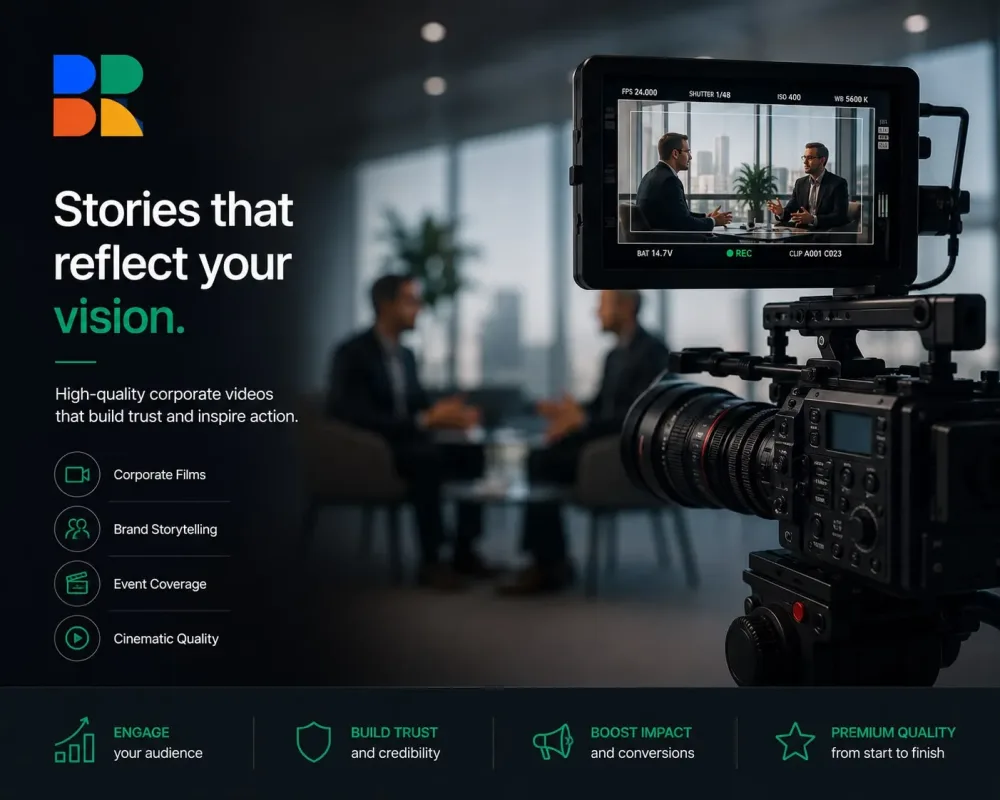
Corporate Video Production visual
logo img
logo img
logo img
logo img
logo img
logo img
logo img
logo img
logo img
logo img
logo img
logo img
logo img
logo img
logo img
logo img
logo img
logo img
logo img
logo img
logo img
logo img
logo img
logo img
logo img
logo img
logo img
logo img
logo img
logo img
logo img
logo img
logo img
logo img
logo img
logo img
logo img
logo img
logo img
logo img

The Film Grew in Review and Nobody Watched It

01

Every department wanted a mention.

The film opened as a message about one thing and closed as a summary of everything, with each section defensible in isolation and the whole unwatchable.
02

It runs eleven minutes and the retention graph collapses at ninety seconds.

Length was determined by what had to be included rather than by what an audience will actually watch.
03

Nobody agreed who approves what.

Comments arrived from people who were not in the brief, contradicting comments from people who were, at a stage where changes are expensive.
04

The executive had forty-five minutes and it was used badly.

One camera, one setup, no coverage, no additional questions captured — so when a second film was needed three months later, the entire session had to be arranged again.
05

The people on camera look uncomfortable, because they are.

Engineers, clinicians, executives and employees asked to deliver scripted lines, filmed without direction, reading from a screen at an angle that makes it obvious.
06

It went out of date within a year.

A named individual left, a figure changed, a facility was rebranded — and because the film was cut as a single continuous piece, updating it meant reshooting it.
07

Site access became the project.

Permissions, safety inductions, confidentiality restrictions, what could appear in frame and who could be identified — all discovered on the day rather than planned for.
08

The global versions never happened.

No captions, no subtitle files, no translation plan, no accessible version, so a film intended for a workforce across several countries only worked for one of them.
09

The recruitment video attracted the wrong candidates.

Produced to look impressive rather than to be accurate, so it drew applications from people the actual job would disappoint.
10

It was measured by whether the leadership team liked it.

Which is a measure of a review meeting rather than of whether anybody understood the message or did anything differently afterward.

20+

Years of experience

5

Global Locations

300+

Active Clients

2%

Top HubSpot Partners Globally

100+

In-house Digital Marketing Specialists

One Film, One Message, One Audience

01

We establish what the film is not about.

Before production, we agree the single message, the single audience and the single action — and, more usefully, the list of things this film deliberately will not cover. Where several messages genuinely need communicating, the answer is several short films rather than one long one. Separate audiences almost always deserve separate versions, and separate versions are cheaper than the loss of attention that comes from combining them.
02

The approval structure is agreed before anyone is filmed.

Who reviews, who comments, who decides, in what sequence, and how many rounds are included. The timeline of a corporate video is determined by review cycles rather than by editing, and an undefined approval process is the most reliable cause of a film arriving late, long and diluted.
03

Executive time is treated as the scarcest resource in the project.

A leadership session is planned to produce a quarter of material, not one film: multiple camera angles for editing flexibility, additional questions captured in the same sitting, alternative openings, and coverage that allows future re-cuts without another booking.
04

We direct people who are not performers.

Most of the people who appear in corporate film do it once and would rather not. Interview technique produces better material than scripted delivery for almost everyone, and where a script is genuinely required we plan the environment, autocue placement and pacing so it does not look like one.
05

Films are built modularly so they can be updated.

Structured with replaceable sections, separated voice and text elements, and organized project files — so that a departing executive, a changed figure or a new facility means an amendment rather than a reshoot. Corporate films are used for years, and planning for that is a production decision made at the outset.
06

Access, consent and confidentiality are planned, not discovered.

Site permissions, safety inductions, what may appear on screens and documents in frame, individual appearance consent, and the handling of anyone who declines. In regulated and secure environments this determines what is filmable, and it belongs in pre-production rather than on the shooting day.
07

Accessibility and language versions are part of the specification.

Captions, subtitle files, translated versions, described audio where required and formats compatible with internal platforms. Internal accessibility obligations are frequently stricter than marketing conventions, and retrofitting them is more expensive than planning them.
08

Multi-site consistency is engineered.

Where filming spans locations or countries, a documented look — framing, lighting approach, audio setup, interview structure — allows directed local crews to produce material that cuts together as one film rather than as a compilation.
09

Success is whether the message landed, not whether the review meeting went well.

Stakeholder satisfaction is a necessary condition and a poor measure. We agree what comprehension or action the film is meant to produce and how that will be checked.

Not sure how many films your brief actually needs?

Request a Production Consultation and we'll tell you how many films it actually is and what each one requires.
Request a Production Consultation

The Components of a Corporate Production Capability

1

Brand, Corporate & Heritage Films

The films that represent the organization: brand and positioning films, founder and origin stories, anniversary and heritage pieces, purpose and strategy communication. Produced with a distribution and re-versioning plan attached, and structured so they remain usable as the organization changes — the film counterpart to a brand awareness and visibility programme.
Influences
stakeholder perception sales support recruitment internal pride
2

Executive & Internal Communications Video

Leadership messages, strategy and change communication, results and all-hands content, and regular internal formats. Planned around limited executive availability and produced to a standard that makes watching preferable to reading a memo — which is the only reason to make one.
Influences
message comprehension employee understanding change adoption internal engagement
3

Employer Brand & Recruitment Video

Careers films, day-in-the-life content, team and culture pieces, and role-specific material. Built for accuracy rather than aspiration, because a recruitment film that oversells the role produces applications that fail at interview or hires that leave within a year.
Influences
application volume and quality candidate self-selection offer acceptance early attrition
4

Training, Onboarding & Compliance Video

Instructional and procedural content, onboarding programmes, health and safety films, and regulatory or policy communication. Built for retention and reference — chaptered, searchable, captioned — and structured for platform hosting and completion tracking.
Influences
time to competency training completion repeat query volume compliance attestation
5

Event, Conference & Live Capture

Multi-camera event coverage, conference and session recording, live streaming, awards and launch films, and the conversion of captured material into highlights, clips and on-demand libraries, planned alongside content creation and distribution rather than published once and abandoned.
Influences
event reach beyond attendees content supply sponsor value asset yield
6

Facility, Capability & Process Films

Site tours, manufacturing and process films, capability and credentials pieces for tenders and procurement submissions, and technical demonstration. Frequently the material that carries a business through a shortlist stage where the buyer cannot visit in person — the video complement to procurement-facing website content creation.
Influences
tender progression buyer confidence sales cycle support partner assurance
7

Investor & Stakeholder Communication

Results presentations, annual report and general meeting content, investor briefings and stakeholder updates. Produced under the accuracy, disclosure and timing constraints these communications carry, with review workflows built to match.
Influences
stakeholder comprehension disclosure compliance communication reach
8

Multi-Site, Multi-Language Production & Accessibility

Coordinated production across locations and countries with a documented visual and audio standard, directed local or remote crews, translation and subtitling, voiceover and dubbing, captioning and accessible versions, and delivery specifications for internal platforms and learning systems.
Influences
global consistency workforce reach accessibility compliance cost of international production
9

Post-Production, Versioning, Archive & Asset Management

Editing, motion graphics, animation, colour and sound, plus the versioning that makes a film last — alternative lengths and cuts, replaceable sections, localized variants, including cut-downs for social media content creation — and an organized archive of masters, raw material, project files and transcripts that your team can search and reuse.
Influences
asset lifespan cost of updates reuse rate dependency on the original supplier

The One Message Model

01 — Define
  • 1 Single message, audience and intended action
  • 2 Explicit list of what the film will not cover
02 — Align
  • 1 Approval map: who reviews, comments, decides, in what order
  • 2 Agreed and documented before production begins
03 — Plan
  • 1 Locations, site access, safety inductions, permissions
  • 2 Consent process, contributor scheduling, shot list
04 — Direct
  • 1 Interview direction for contributors who are not performers
  • 2 Multi-camera coverage and future-version capture in one session
05 — Assemble
  • 1 Editing to the agreed message and length
  • 2 Modular construction, separable graphics and sound
06 — Review
  • 1 Structured review against the approval map
  • 2 Consolidated feedback, defined number of rounds
07 — Adapt
  • 1 Alternative lengths, cuts and language versions
  • 2 Subtitles, captions, accessible variants, platform formats
08 — Deliver
  • 1 Final files to the required specifications
  • 2 Organized archive of masters, footage, transcripts handed over
09 — Sustain
  • 1 Scheduled re-versioning as people, figures and facilities change
  • 2 Amendment rather than reshoot — or told plainly when it is finished

Working cadence during a project: weekly production updates with a single project owner, consolidated review rounds at agreed points, and a documented change process for requests outside the original brief.

Planning a leadership or all-hands film?

Talk to a Producer about how to get a quarter of material from a single executive session.

Talk to a Producer

We Will Protect the Film From the Review Process

01

One message per film, agreed in writing.

Including the exclusions. When new requirements arrive mid-project, we return to that agreement rather than quietly lengthening the film.
02

Approval structure defined before filming.

Named reviewers, defined sequence, agreed rounds. This is the single largest determinant of whether a corporate video is delivered on time and still says what it set out to say.
03

Executive sessions planned to yield a quarter.

Multiple angles, additional questions, alternative openings and coverage for future edits — because the hardest thing to book twice is a leadership diary.
04

Direction for people who do not want to be on camera.

Interview technique rather than scripted delivery wherever possible, and where a script is required, an environment and pace that does not advertise it.
05

Modular construction so films can be amended.

Replaceable sections and organized project files, so a departure or a changed figure costs an edit rather than a production.
06

Access, consent and confidentiality handled in pre-production.

Site permissions, safety requirements, what may appear in frame, and a documented consent process for everyone who appears.
07

Accessibility and language versions specified from the start.

Captions, subtitles, translations and accessible formats built into scope rather than requested afterward at a premium.
08

Consistency across sites and countries.

A documented production standard that allows local or remote crews to deliver material that cuts together as a single film.
09

Full ownership.

Masters, raw footage, project files, graphics assets, transcripts, subtitle files and music licences belong to you and transfer with you — including everything unused.

Where Corporate Production Differs

Manufacturing and Industrial

Site safety inductions, machinery and process filming, protective equipment requirements, and confidentiality about production methods. Pre-production carries more weight than shooting.

Healthcare and Life Sciences

Patient privacy and consent, clinical accuracy, infection control constraints in filmed environments, and regulatory review of anything instructional or claim-bearing.

Financial and Professional Services

Disclosure requirements, compliance review of spoken content, and communications that must be accurate to a standard well beyond marketing convention.

Energy, Utilities and Infrastructure

Remote and hazardous locations, permit and access lead times, safety-critical training content, and stakeholder communication with public and regulatory audiences.

Technology and Enterprise

Distributed workforces requiring multi-language internal communication, screen capture combined with human presence, and rapid production cycles around product and organizational change.

Education and Research

Consent for students including minors, campus and facility access, and content serving prospective, current and alumni audiences from the same production.

Public Sector and Non-Profit

Accessibility obligations that are legally binding rather than advisory, plain-language requirements, multi-stakeholder approval, and public scrutiny of production cost.

Professional Membership and Associations

Conference and event capture at scale, member communication, and content that must serve a broad membership without favouring any part of it.

Whether the Message Landed, Not Whether the Room Approved

01

Communication outcomes

  • Comprehension and recall, tested through internal surveys or pulse checks after distribution
  • Completion rate on internal platforms, which for most corporate film is the honest measure of whether it was the right length
  • Action taken: policy acknowledgement, enrolment, attendance, attestation or whatever the film asked for
  • Query volume to the relevant team before and after, where the film was intended to answer common questions
02

Function-specific outcomes

  • Recruitment: application volume and quality, candidate self-selection, offer acceptance and early attrition
  • Training: completion rates, assessment performance, time to competency, repeat instruction requests
  • Tender and capability films: shortlist progression where the film formed part of a submission
  • Investor and stakeholder content: reach among the intended audience and comprehension of the message
03

Production outcomes

  • Delivery against agreed schedule
  • Review rounds used against rounds contracted, which is the clearest indicator of whether the brief was properly defined
  • Cost per finished minute, and cost per usable asset where a session produced several
  • Reuse rate and asset lifespan before amendment is required
  • Proportion of contracted deliverables produced from within the planned production days

On honest scope. Where a brief contains several messages for several audiences, we will propose several short films rather than one long one, and we will explain the cost comparison openly — it is usually favourable, and it is always favourable once attention is accounted for. Where an existing film could be re-cut to meet a new requirement, we will recommend that instead of a new production.

On horizons. Internal comprehension and completion data is available within weeks of distribution. Recruitment and training effects take a quarter or more to read reliably. Brand and heritage films deliver most of their value across several years, provided they were built to be updated rather than replaced.

Frequently Asked Questions

1. How is this different from your video marketing service?
Video marketing plans and distributes video as a marketing medium — channel strategy, YouTube, paid video, funnel coverage and pipeline measurement. This is production for organizational communication: films made for employees, executives, candidates, investors, regulators, event audiences and procurement panels. Different buyers, different constraints, different measures. Clients frequently use both, and the two are scoped separately because the approval environments have almost nothing in common.
2. Our executives are uncomfortable on camera. How do you handle that?
By not asking them to perform. Interview-led filming produces more natural and more usable material than scripted delivery for almost everyone, and it can be edited into something that reads as considered rather than read. Where a script is genuinely necessary, we plan autocue placement, environment and pacing so it is not obvious, and we allow enough time for people to settle — which usually costs twenty minutes and improves everything that follows.
3. How do we stop the film growing to eleven minutes during review?
By agreeing the single message and the exclusions before filming, and by defining who reviews, who decides and how many rounds are included. When additional requirements arrive, they are assessed as a change — either accepted with the schedule adjusted, or proposed as a second, shorter film. Most length problems are governance problems, and they are solved in stage two rather than in the edit.
4. How much executive time do you need?
Typically forty-five to ninety minutes for a filmed session, and we plan it to produce considerably more than one film — multiple camera angles, additional questions and alternative openings captured in the same sitting. We provide questions in advance, keep the setup unobtrusive, and work around the diary rather than asking it to accommodate us.
5. Can you film across multiple sites and countries?
Yes, through a combination of travelling crew, directed local crews and remotely directed production depending on the quality requirement, frequency and travel economics. Consistency comes from a documented production standard covering framing, lighting, audio and interview structure, so material shot in different places cuts together as one film.
6. How do you handle confidentiality, site access and consent?
In pre-production. Non-disclosure agreements, site permissions and safety inductions arranged in advance, an agreed list of what may and may not appear in frame including screens and documents, a documented appearance consent process for everyone filmed, and a defined approach for individuals who decline. In secure and regulated environments these constraints shape the shot list rather than being managed around it.
7. How long does a corporate film take, and how is it priced?
Priced by scope — shoot days, locations, crew size, contributor count, animation and graphics requirements, language versions and deliverable count. Timelines are usually determined by contributor availability and review cycles rather than by production or editing time. We quote review rounds explicitly so that the schedule reflects your actual approval environment rather than an optimistic one.
8. Can a film be updated later instead of reshot?
That is a design decision we make at the outset. Films are built with replaceable sections and separated graphics, text and voice elements, and we retain organized project files and unused footage. A changed statistic, a departed contributor or a rebranded facility can then usually be handled as an amendment. It is the single most valuable thing you can ask a producer to plan for, and it is rarely requested.

The Film Everyone Approved Is Not the Same as the Film That Worked

Corporate video is judged twice: once in a review meeting, and once by an audience who owes it nothing. Most of the decisions that determine the second outcome are made before filming — how many messages the film is carrying, who is allowed to add to it, and whether the people appearing were directed or simply recorded. If your last corporate film took four months, ran twice as long as intended and is already out of date, none of that was an editing problem.

Request a Production Consultation

Tell us what needs communicating, to whom, and who has to approve it. We will tell you how many films that actually is, what each one requires, and how much of your executives' time it will take.

United States

BrandReturns Global LLC

Wyoming, United States

Corporate Address

30 N Gould St
Ste R
Sheridan, WY 82801
United States

Phone

+1 646-347-1661

Email

info@brandreturnsglobal.com

Tell Us About Your Project

By submitting this form, you agree that BrandReturns may use the information provided to respond to your enquiry and communicate with you about relevant services. Your information will be handled in accordance with our Privacy Policy.

WhatsApp