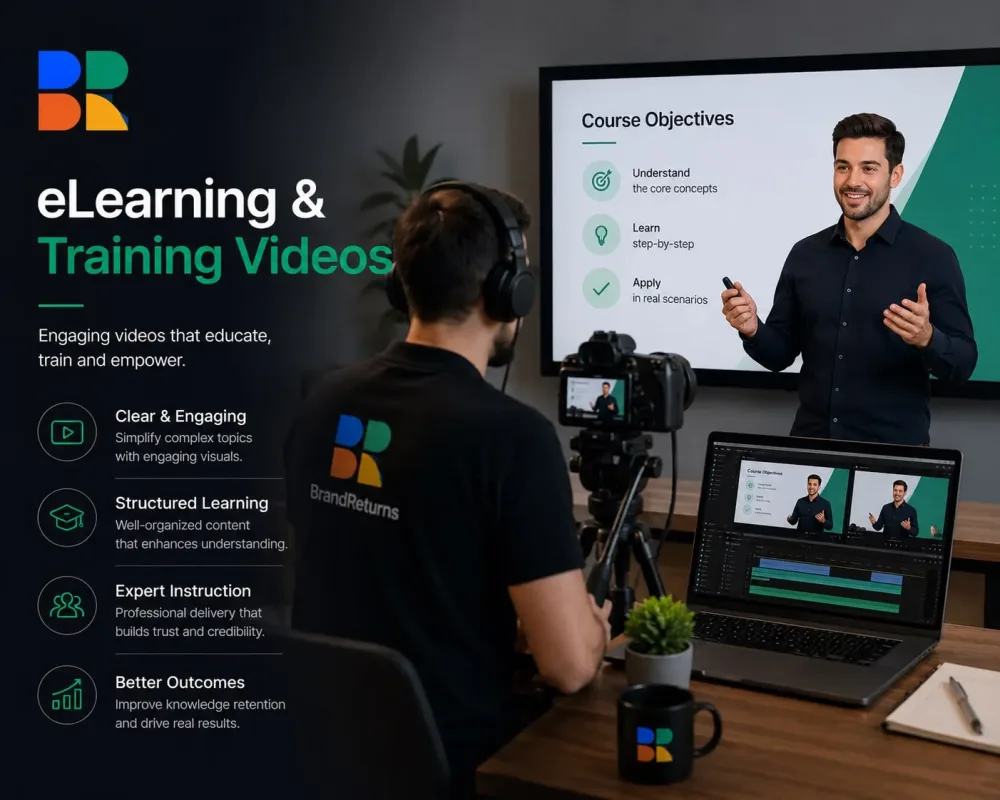
eLearning & Training Videos
eLearning and Training Videos Built Around Capability, Not Completion
A training module everybody finished and nobody can apply has failed at the only thing it was funded to do. Completion rates conceal this, which is why they are the metric most often reported. BrandReturns designs learning content around what a person must be able to do afterwards — segmented for how attention and memory actually work, assessed against capability rather than recall, integrated with your learning platform, and built modularly so it can be updated when the process changes.
Tell us what people need to be able to do and what currently goes wrong. We will tell you what should be video, what should not be, and how it should be structured.
Our Work
Everyone Completed the Module and Nothing Changed on the Floor
It runs forty-five minutes because that was convenient to produce.
The content went stale within a year.
Your experts have no time, so the content is generic.
It should never have been a video.
It does not work properly on the learning platform.
A global workforce received one language and no captions.
The assessment tests whether they watched.
New starters get a six-hour playlist on day one.
Compliance training exists to prove it happened.
20+
Years of experience
5
Global Locations
300+
Active Clients
2%
Top HubSpot Partners Globally
100+
In-house Digital Marketing Specialists
Start From the Performance Gap, Not the Content List
We begin with what people must be able to do, and whether training is the answer.
Learning objectives are written as observable behaviour.
Content is segmented because attention and memory are.
Format is chosen per objective, and sometimes the answer is not video.
Subject-matter expertise is extracted, not requested.
Assessment tests application, not recall.
Built modularly because training content decays fastest.
Platform integration and accessibility are specification, not afterthought.
Piloted with real learners before rollout.
Measured on what changed at work.
Not sure whether training is even the right fix?
Request a Learning Content Review and we'll tell you whether training is the answer, and what should be video.
Request a Learning Content ReviewThe Components of a Learning Content Engagement
Learning Needs Analysis & Performance Objectives
Instructional Design & Curriculum Architecture
Scripting & Subject-Matter Extraction
Instructional Video Production
Animated & Simulated Learning Content
Interactivity, Assessment & Knowledge Checks
Learning Platform Integration & Technical Delivery
Accessibility, Localisation & Multi-Market Versioning
Measurement, Maintenance & Content Lifecycle
The Applied Learning Model
- 1 Performance gap, causes, audience, starting knowledge
- 2 Determination of whether training is the right intervention
- 1 Learning objectives written as observable behaviour
- 2 Assessment approach and the business indicator to influence
- 1 Curriculum architecture, segmentation, sequencing, spacing
- 2 Learner pathways by role, format selected per objective
- 1 Structured expert extraction sessions
- 2 Script, accuracy and compliance review, approved before production
- 1 Filming, animation, screen capture, asset creation
- 2 Modular sections with separated text and voice layers
- 1 Interactivity, assessment, knowledge checks
- 2 Navigation and packaging assembled into learning objects
- 1 Deployment to your learning platform
- 2 Tracking, reporting, resumption tested on real devices
- 1 Pilot with a representative group of real learners
- 2 Comprehension, usability, capability tested before rollout
- 1 Measurement against agreed indicators
- 2 Scheduled review cycles, modular updates as things change
01 — Diagnose
- 1 Performance gap, causes, audience, starting knowledge
- 2 Determination of whether training is the right intervention
02 — Define
- 1 Learning objectives written as observable behaviour
- 2 Assessment approach and the business indicator to influence
03 — Design
- 1 Curriculum architecture, segmentation, sequencing, spacing
- 2 Learner pathways by role, format selected per objective
04 — Script
- 1 Structured expert extraction sessions
- 2 Script, accuracy and compliance review, approved before production
05 — Produce
- 1 Filming, animation, screen capture, asset creation
- 2 Modular sections with separated text and voice layers
06 — Build
- 1 Interactivity, assessment, knowledge checks
- 2 Navigation and packaging assembled into learning objects
07 — Integrate
- 1 Deployment to your learning platform
- 2 Tracking, reporting, resumption tested on real devices
08 — Validate
- 1 Pilot with a representative group of real learners
- 2 Comprehension, usability, capability tested before rollout
09 — Sustain
- 1 Measurement against agreed indicators
- 2 Scheduled review cycles, modular updates as things change
Working cadence: stage approvals with a single decision-maker, consolidated review rounds at script and build stages, and a scheduled annual or event-driven content review after rollout.
Need to prove this training actually worked?
Talk to a Learning Designer about the difference between completion and demonstrated capability.
Talk to a Learning DesignerWe Will Tell You When It Should Not Be a Video
The diagnosis can conclude against training.
Format chosen per objective.
Objectives written as behaviour.
Segmented by design.
Expert time treated as the scarce resource.
Assessment that distinguishes watching from doing.
Piloted before rollout.
Built to be updated.
Accessibility and language versions specified from the start.
Full ownership.
Where Learning Content Carries Different Requirements
Safety-critical procedure, machine operation and maintenance, where incorrect performance has physical consequences and evidence of competence is a regulatory requirement rather than a preference.
Clinical procedure, device operation, patient safety and mandatory training, produced under clinical review with competency verification that must withstand inspection.
Regulatory and conduct training, anti-money-laundering, product knowledge and complaints handling, where attestation records and audit trails are examined by regulators rather than by internal audit alone.
High turnover, distributed sites and predominantly mobile access, requiring short modules, fast onboarding and content that works on a phone in a stockroom.
Safety-critical work in hazardous environments, contractor induction, permit and procedure training, frequently delivered offline at remote sites.
Two audiences from one capability — internal enablement for staff, and <a href="https://gafoorjeetextile.com/website-design-development-services/website-crm-email-marketing">customer education programmes</a> that reduce support load and improve retention. The second is frequently under-built and commercially significant.
Distributed and shift-based workforces, driver and operative training, compliance requirements varying by jurisdiction, and low tolerance for time away from operations.
Accessibility obligations that are legally binding, plain-language requirements, multi-stakeholder approval, and public scrutiny of both content and cost.
Whether People Can Do It, Not Whether They Finished It
Capability and behaviour outcomes
- Demonstrated performance of the task, assessed practically or verified by a supervisor
- Error, defect, incident or non-compliance rates before and after, where the content targeted a specific failure
- Time to competency for new starters
- Retention checked after a delay rather than immediately, since immediate recall overstates learning substantially
- Quality or accuracy indicators relevant to the work concerned
Business outcomes
- Support and helpdesk volume where the content answers common issues
- Ramp time and early attrition among new hires
- Customer retention and expansion where the programme is customer education
- Rework, waste or claim costs attributable to the process taught
- Audit and inspection outcomes where the training carries regulatory weight
Programme diagnostics
- Assessment performance, and the specific questions failed most often, which usually identifies a design fault rather than a learner fault
- Drop-off points within modules, mapped to content sections
- Replay behaviour, which reliably indicates a passage people did not understand
- Search behaviour where reference material is provided
- Time taken against time estimated
Operational outcomes
- Accuracy and currency of the library against the review schedule
- Cost and turnaround of updates when a process changes
- Cost per additional language version
- Accessibility conformance level achieved
On what training cannot fix. If people know what to do and do not do it, the constraint is process, tooling, workload, incentives or supervision. We will identify that during analysis and say so plainly. Producing content in that situation creates an audit record and a false sense that the problem has been addressed, which is worse than doing nothing.
On horizons. Comprehension is measurable immediately. Retention should be checked at thirty and ninety days, because the gap between those two figures is where most programmes are quietly failing. Behavioural change becomes visible over a quarter. Business indicators such as incident rates, ramp time and support volume typically need six to twelve months and enough volume to read reliably.
Frequently Asked Questions
1. How is this different from your corporate video production service?
2. How do we know whether the training actually worked?
3. Our subject-matter experts have almost no time. How does this work?
4. Should this be video at all?
5. How long should modules be?
6. Will it work on our learning platform?
7. How do we keep it current when processes and regulations change?
8. Do you handle accessibility and translation, and how is this priced?
A Completion Report Is Not Evidence That Anyone Learned Anything
Training budgets are defended with completion figures because they are the number the platform produces and the number auditors accept. They describe whether people opened something. They say nothing about whether the work changed, which is the only reason the content was funded. If your modules are finished by everyone and applied by few, or your library went out of date faster than you could update it, both problems were designed in before production started.
Request a Learning Content Review
Tell us what people need to be able to do and what currently goes wrong. We will tell you whether training is the answer, what should be video, and how it should be structured and measured.
United States
BrandReturns Global LLC
Wyoming, United States
Corporate Address
30 N Gould St
Ste R
Sheridan, WY 82801
United States